Jeffrey Weil / August 26, 2025
The Rise of Raising Cane’s: From Baton Rouge to a Net Lease Powerhouse
In the world of quick-service dining, few stories capture the imagination quite like that of Raising Cane’s. What began in 1996 as a single chicken-finger restaurant near Louisiana State University has blossomed into a national sensation with nearly 1,000 locations as of August 2025. Fueled by a singular vision—serving quality chicken fingers with unmatched consistency—the brand has built not only a loyal following but also one of the strongest financial footprints in the restaurant industry.
Humble Beginnings
The story starts with Todd Graves, a college student whose business plan for a chicken-finger concept earned a less-than-stellar grade. Undeterred, he worked a series of tough jobs to raise money for his dream, eventually opening the first Raising Cane’s in Baton Rouge. Named after his yellow Labrador Retriever, “Cane,” the restaurant was an instant hit. Its stripped-down menu, centered entirely on chicken fingers, was radical in its simplicity but resonated with customers who craved quality over complexity.
Explosive Growth Through 2025
Nearly three decades later, Raising Cane’s has become one of the fastest-growing restaurant chains in the country. Over the past two years, the company has opened more than 200 new locations, crossing the 900-unit mark in 2025. With annual revenues surpassing $5 billion and average unit volumes (AUVs) above $6.5 million, Raising Cane’s consistently outperforms not only its chicken-focused peers but many of the world’s largest restaurant brands.
The expansion shows no signs of slowing. New flagship restaurants in Chicago, Austin, and Southaven, Mississippi have drawn massive crowds, while the pipeline includes dozens more openings across the Northeast, West Coast, and international markets. By 2030, Raising Cane’s has set its sights on 1,600 locations and $10 billion in annual sales, positioning itself firmly within the top ten U.S. restaurant brands.
Industry-Leading Economics
Raising Cane’s growth is not fueled by hype alone—it is supported by industry-leading economics. The company’s AUVs rank second only to Chick-fil-A, often exceeding $6.6 million per location compared with an industry average closer to $2.8 million. Sales growth has been relentless, with more than 15 consecutive years of same-store increases.
Much of this success is owed to operational efficiency. Drive-thru sales account for nearly 70 percent of revenue, while streamlined menus reduce labor costs and improve consistency. These fundamentals make Raising Cane’s not just a strong restaurant brand, but also a highly attractive real estate tenant.
A Net Lease Investor’s Dream
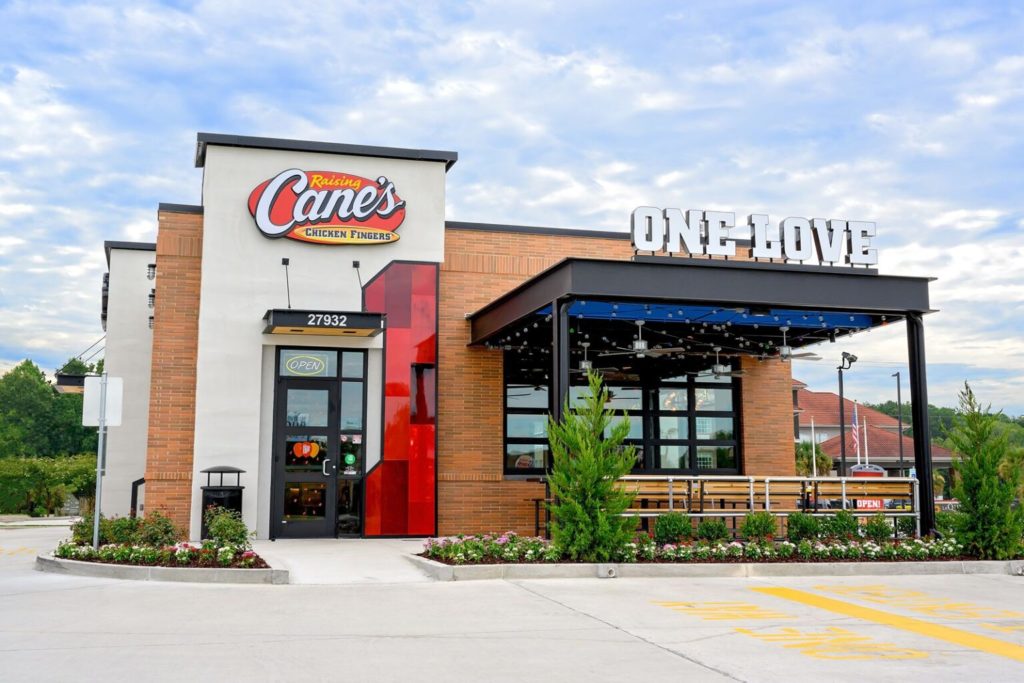
For investors in net lease real estate, Raising Cane’s has become one of the most sought-after tenants in the quick-service sector. Many new stores are secured under 15-year ground leases, providing stable, long-term income streams. With corporate guarantees and robust sales volumes, Raising Cane’s properties offer both security and growth potential.
The chain’s strong financial performance, coupled with disciplined site selection in high-traffic corridors, has fueled investor demand. Properties often trade at premium cap rates, reflecting the market’s confidence in the brand’s ability to generate consistent cash flow well into the future.
Looking Ahead
As Raising Cane’s enters its fourth decade, the company’s vision remains remarkably clear: do one thing, and do it better than anyone else. That clarity has translated into soaring revenues, record-breaking AUVs, and an aggressive expansion strategy that shows no signs of slowing.
For diners, that means more chances to enjoy a basket of golden chicken fingers and Cane’s sauce. For investors, it means one of the most reliable and compelling opportunities in the net lease market today.
Raising Cane’s has not just built a restaurant chain—it has built a brand with staying power, both at the table and on the balance sheet.
Jeffrey Weil, November Capital